Why Security Controls Fail and How the Adaptive Security Change Model Fixes That
Most cyber and physical security leaders have asked themselves this question at some point.
The policy is approved. The technology works. The risk makes sense on paper. And yet, when pressure rises, people hesitate, work around the control, or make decisions that increase risk instead of reducing it.
This gap between security intent and real-world behavior is exactly why the Adaptive Security Change Model (ASCM) was developed.
The Adaptive Security Change Model is grounded in organizational change management, IT user adoption, and operational security leadership. It reflects years of observing the same pattern repeat across cyber, physical, and converged security environments.
Security does not break because people are careless. It breaks because decision systems fail under pressure.
What is the Adaptive Security Change Model?
The Adaptive Security Change Model (ASCM) is a decision-centric framework designed to help security leaders drive change that holds when conditions destabilize.
Rather than treating security change as a one-time rollout of controls or policies, ASCM treats security as an adaptive decision system. It focuses on how leaders and teams interpret risk, make trade-offs, and act collectively during moments of uncertainty.
This approach aligns with organizational change research showing that most change initiatives fail not due to poor strategy, but because human cognitive and behavioral responses are not adequately addressed during execution under stress.
ASCM exists to close that gap.
Why security leadership needs a different approach to change
Security is uniquely vulnerable to change failure.
Unlike many operational disciplines, security deliberately introduces friction. Controls often slow work down, restrict autonomy, and signal risk. Neuroscience and organizational psychology research shows that perceived threat and uncertainty activate stress responses that reduce learning, collaboration, and adaptability.
Traditional security change approaches often rely on compliance logic:
Publish the policy
Train the workforce
Enforce adherence
Yet studies consistently show that compliance pressure alone does not produce durable security behavior. Leadership behavior, clarity of authority, and shared mental models have a greater impact on how people actually behave when it matters.
ASCM reframes security change as decision leadership, not rule enforcement.
How organizational change and user adoption shaped ASCM
The foundation of ASCM comes directly from organizational change management and IT user adoption science.
Change research shows that people do not resist change itself, they resist loss of clarity, control, and confidence. In security contexts, this resistance often appears as workarounds, delay, or silent non-adoption.
User adoption research reinforces the same point. Adoption depends on perceived usefulness, ease of use, and self-efficacy. When security controls increase cognitive load or break workflows, risk increases rather than decreases.
ASCM integrates these insights into a single framework that reflects how security actually operates under pressure.
Explore the Full ASCM Framework
The Adaptive Security Change Model consists of seven interconnected elements, from shared risk context and change triggers to leadership judgment, team behavior under pressure, and embedded organizational learning.
These elements don't function as sequential steps. They operate as a system. When one weakens, adaptive capacity degrades across all the others.
Ready to see how it works?
👉 Explore the complete ASCM framework → The Adaptive Security Change Model (ASCM)
Discover how each element is designed to reinforce decision-making when conditions destabilize, and what security leaders can do to build genuine adaptive capacity in their organizations.
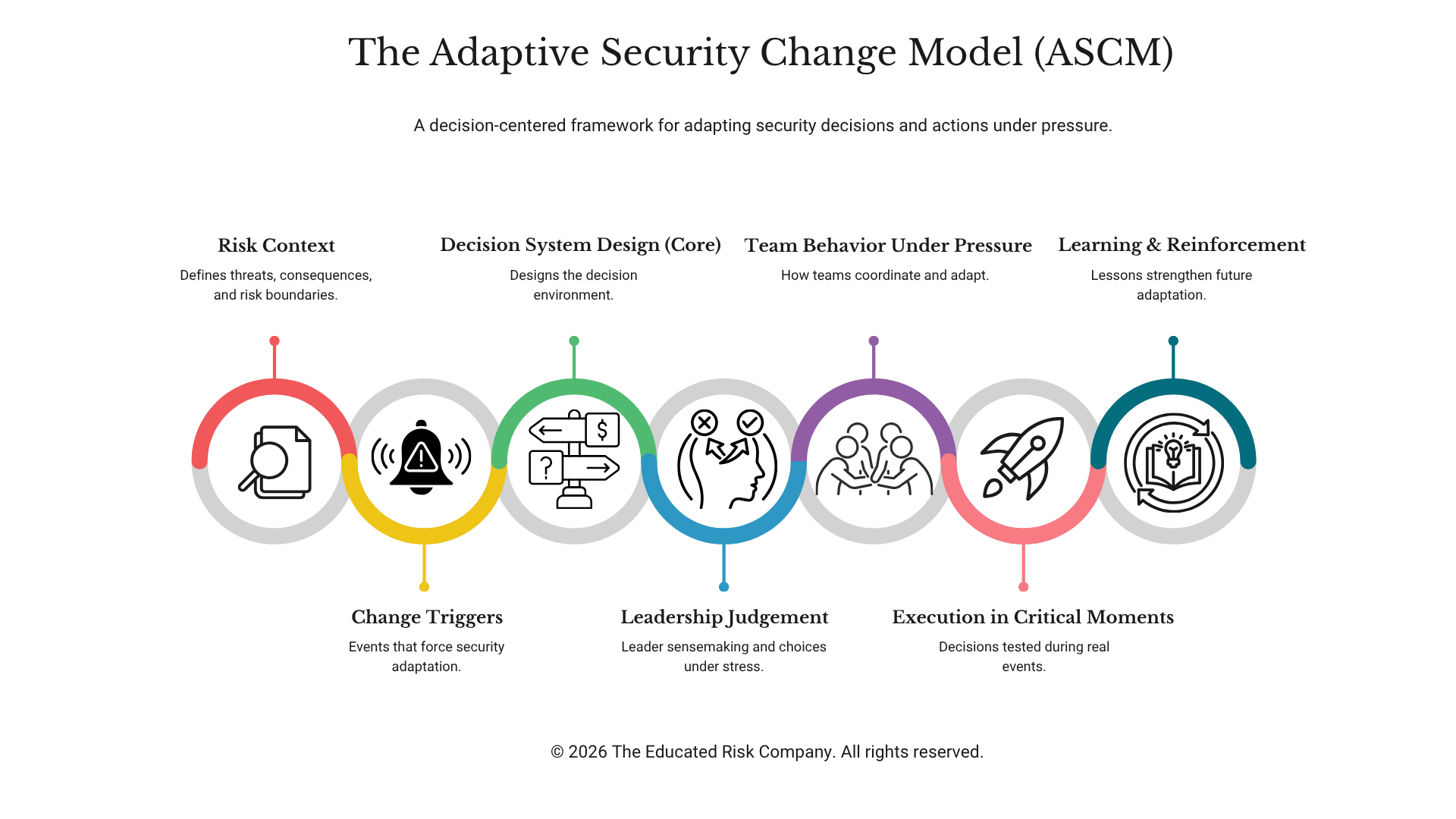
Adaptive Security Change Model showing how risk, decisions, leadership, execution, and learning connect.
Practical takeaways for security leaders
Whether or not your organization is ready to adopt ASCM in full, the model points to a few immediate shifts that improve security performance:
Measure behavior, not just compliance. Policy adherence and actual decision behavior are not the same thing. Closing that measurement gap changes what leaders pay attention to.
Design decision authority before incidents occur. When authority is ambiguous during a crisis, teams hesitate, escalate upward unnecessarily, or act without coordination. Pre-designed decision systems prevent this.
Treat incidents as decision diagnostics, not failures. Every incident reveals whether authority was clear, whether teams adapted or froze, and whether decisions aligned with enterprise intent.
Practice judgment, not just procedures. Strong leadership judgment under pressure is a capability that can be designed, practiced, and reinforced, not something that emerges from training alone.
Security performance improves when leaders invest in how decisions are made, not just what controls exist.
Frequently Asked Questions
Is ASCM a replacement for NIST, ISO, or other frameworks? No. ASCM complements existing frameworks by addressing how security decisions are made under pressure, the human and organizational layer that standards-based frameworks do not fully cover.
Is ASCM only for cybersecurity? No. The model applies to physical security, converged programs, and enterprise risk leadership wherever human decision-making is a factor.
Where did ASCM originate? ASCM originated from direct experience integrating organizational change management, IT user adoption science, and security operations leadership.
Final thoughts
Security leadership is change leadership.
The Adaptive Security Change Model exists to shift security programs from control implementation to adaptive decision capability, the kind that holds not when conditions are calm, but when they're not.
If you want security change that works under pressure, start by designing decisions, not just defenses.
Explore the full ASCM framework → The Adaptive Security Change Model (ASCM)
References
Errida, A., & Lotfi, B. (2021). The determinants of organizational change management success: Literature review and case study. International Journal of Engineering Business Management, 13, 1–15.
Hasani, T., O'Reilly, N., Dehghantanha, A., Rezania, D., & Levallet, N. (2023). Evaluating the adoption of cybersecurity and its influence on organizational performance. SN Business & Economics, 3(97).
Khaw, K. W., Alnoor, A., AL-Abrrow, H., Tiberius, V., Ganesan, Y., & Atshan, N. A. (2022). Reactions towards organizational change: A systematic literature review. Current Psychology, 42, 19137–19160.
McCreedy, R. T. W. (2024). Change on the brain? The neuroscience of organizational transformation. International Journal of Applied Research in Management and Economics, 7(3), 30–44.
Moustafa, A. A., Bello, A., & Maurushat, A. (2021). The role of user behaviour in improving cybersecurity management. Frontiers in Psychology, 12, 561011.
Tejay, G. P. S., & Winkfield, M. (2025). Does leadership approach matter? Examining behavioral influences of leaders on employees' information security compliance. Information Systems Frontiers.